
Revolver shotguns: how a .410 revolver shotgun works
WOR ARMS team ·
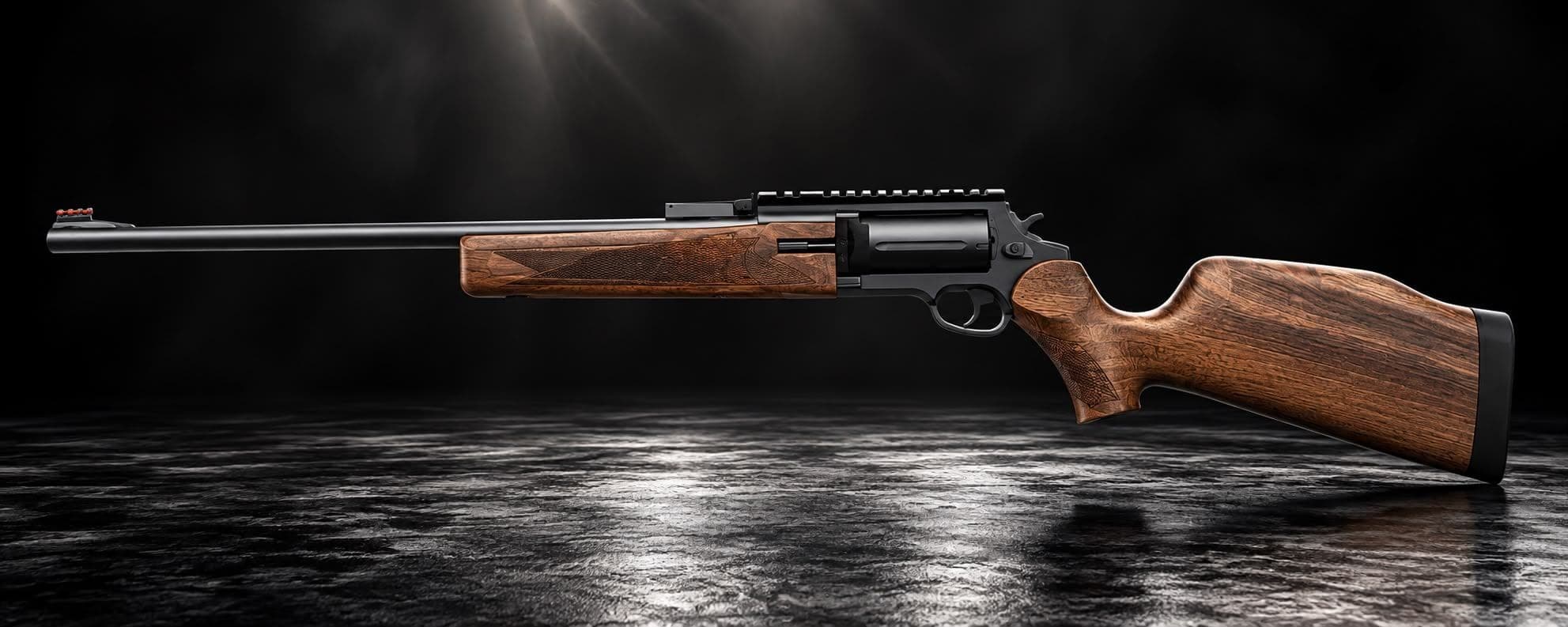
A revolver shotgun is a smoothbore gun that carries its shells in the chambers of a rotating cylinder. Each time it cycles, the cylinder turns one chamber and the next shell lines up with the barrel. No bolt or lever movement is needed. Examples exist in .410 and 12 gauge, among other sizes.
How does a revolver shotgun work?
In a revolver, the cylinder holds several chambers and each chamber takes one cartridge. Cocking the hammer advances the cylinder to the next chamber. The cocked hammer then locks the cylinder in place, so the chamber stays lined up with the barrel for the shot. The shot travels from the cylinder into the barrel.
What makes this reliable is Colt's ratchet-and-pawl mechanism. The shooter does not have to turn the cylinder by hand, because the movement of the hammer does it.
In single action, you cock the hammer as a separate move and the trigger only releases it, which lightens the pull. In double action, one long trigger pull cocks the hammer, turns the cylinder and releases the hammer. That is faster but needs a heavier pull. Most modern revolvers can work either way.
Which mode a gun offers depends on its design. For the WOR Revolver .410 this detail is not among the verified values, so we do not state it here.
What is the cylinder gap?
So that the cylinder can turn, a small gap sits between the cylinder and the barrel, and the shot has to cross it. The gap adds to the noise of the report and is why revolvers generally work poorly with suppressors, which only reduce muzzle noise.
The Nagant M1895 is an exception: its cylinder moves forward and the cartridge case seals the gap. The detail shows that the gap is a natural result of the design.
What is the history of revolving shotguns?
The idea is old. Colt made revolving shotguns in 1839 and 1855 for a short time. They sold poorly and are now among the rarest Colt firearms.
The Model 1839 was made only from 1839 to 1841. That date shows the idea is about 190 years old.
Among modern examples, the Armsel Striker held ten 12 gauge shells in its cylinder, and Cobray copied it as the Streetsweeper. The Russian MTs255 works from a rotating cylinder of five shells and was offered in 12, 20, 28 and 32 gauge and in .410. The Taurus Judge is a handgun that fires .45 Colt and .410 shells, and its carbine version is the Taurus/Rossi Circuit Judge. These examples differ a great deal in size and capacity.
How does the revolver action differ from other actions?
In a lever-action gun the next shell comes to the chamber through the lever movement, and in a semi-automatic through gas or inertia energy. In a revolver the shells already sit in separate chambers, and the hammer or trigger provides the advance. That difference affects capacity, weight distribution and the length of the gun.
Capacity varies by model. A lever action with a tube magazine and a revolver with a cylinder hold different numbers of shells, and each model page lists its own capacity.
You can see other actions using the same shell in our collection: the WOR Lever Action .410 is a lever action, and the WOR Tactical .410 is inertia and gas-operated. It is also worth noting that the Taurus Circuit Judge has a rifled barrel, so not every revolving gun is smoothbore.
What are the features and limits of the revolver action?
As a general mechanism, moving to the next shell happens by cocking the hammer or pulling the trigger. The step does not depend on recoil or gas energy. Because the shells sit in separate chambers, capacity is set by the number of chambers. The examples above range from 5 to 10.
On the other side, the cylinder widens the body and the gap adds noise. Which of these matters to you depends on how you plan to use the gun.
Not every revolving gun uses the same shell either. The sources show the MTs255 in five sizes (12, 20, 28 and 32 gauge and .410) and the Striker in 12 gauge. The word "revolver" describes a mechanism, not a size, so when you look at a model, find out its size separately.
Which basic safety rules apply to a revolver shotgun?
As with every firearm, keep the muzzle pointed in a safe direction, keep your finger outside the trigger guard until you are ready to fire, and check that the gun is empty every time you pick it up. Load each chamber only with a shell that suits the chamber size of the gun.
These are general rules. The manual for your gun always comes first, so read it from start to finish before the first use.
Where can I find details of the WOR Revolver .410?
The WOR Revolver .410 is a .410 bore revolver shotgun. Its capacity, weight and barrel options sit in the specifications table on the model page. To set it beside the other models, see the model comparison table.
We explain what the .410 size means in our .410 guide. Sales are made only through authorised dealers, and this site publishes no prices.
The model page carries a gallery, a specifications table and frequently asked questions. Every value is published only after it has been verified, and an unverified value is never shown.
Who should I ask about licensing and rules of use?
Licensing, ownership and carrying conditions for a revolver shotgun can change from country to country and with the legal class of the gun. This guide gives no legal information. Ask the competent authorities and your authorised dealer.
For technical questions, you can write to us through the contact page.
Sources
Related models
More guides
This article is general information, not legal advice. For licensing and rules, ask the competent authorities and your dealer. Sales are made only through authorised dealers.